

How to Choose the right Sensor Solution for your operational needs
About Author

Izabela is the digital marketing specialist at InThing.
How do location sensors work?
All location sensors are electronic devices but every type has a different purpose, applicability and limitations.
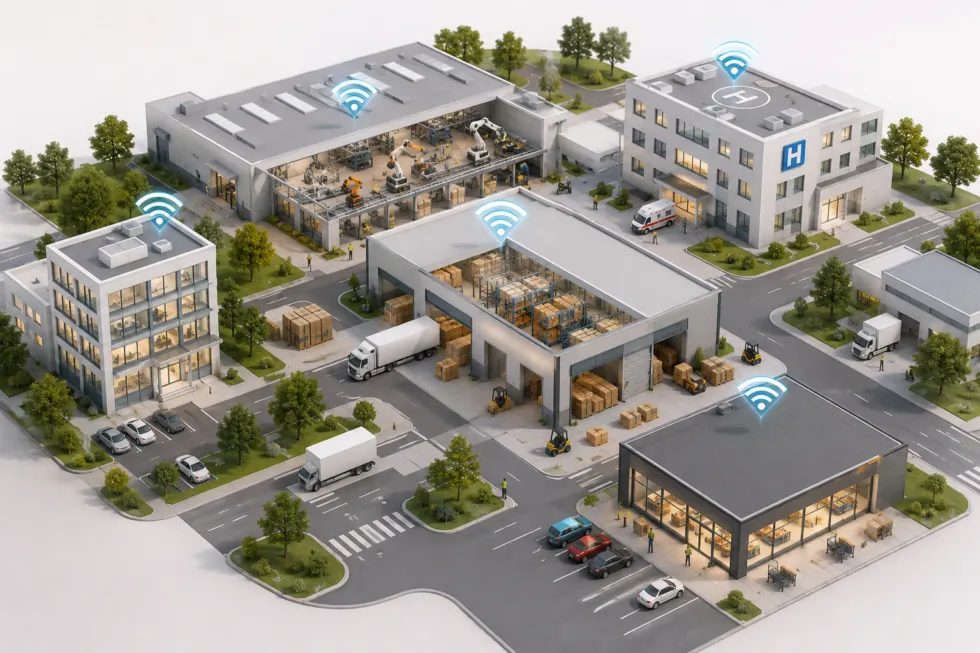
Types of RFID solutions and their applications
Passive RFID is one of the most widely used and inexpensive sensors for inventory, asset tracking, retail, manufacturing, and warehouse operations. These tags do not have batteries. They are powered by the reader signal, which makes them cost-effective for tracking large numbers of items. Each RFID tag contains a microchip and antenna. When the tag comes within range of a reader, it transmits its unique ID and, depending on the tag type, additional information. The reader captures that data and sends it to software that turns raw reads into useful business events: asset located, shipment verified, inventory updated, item moved, tool returned, or exception detected.
Active RFID uses battery-powered tags that transmit signals over longer distances. These sensors, such as BLE or *UWB”, are more expensive to deploy due to cost of tags and infrastructure but they allow assets to announce their location in real-time and at frequent intervals. That means no assets can go out of sight.
These are useful for high-value assets, vehicles, containers, equipment, or large-site tracking where a longer range and always-on visibility is required.
HF and NFC RFID are often used for access control, payments, authentication, document tracking, and item-level interactions at shorter ranges.
The best solution depends on what you need to track. For example, a warehouse may use UHF RFID for pallets and cases. A hospital may use RFID or BLE for medical equipment. A manufacturer may combine RFID with barcode, BLE, or UWB to track tools, WIP, returnable containers, and materials across production stages.
Factors to consider when choosing an RFID solution
-
Business goals : Are you trying to reduce inventory errors, eliminate search time, prevent asset loss, improve shipment accuracy, automate audits, or increase production visibility? A good RFID solution should be selected around measurable business outcomes, not just technology features.
-
Operating environment : Metal surfaces, liquids, dense shelving, dock doors, production equipment, forklifts, and human movement can all affect RFID performance. Site assessment and proper reader placement are critical.
-
Asset type : A laptop, pallet, surgical device, returnable container, and production traveler may each require a different tag, reader setup, and workflow. One-size-fits-all RFID rarely works well.
-
Software capabilities : Hardware captures data, but software creates value. Look for real-time dashboards, exception alerts, duplicate read filtering, location history, audit trails, reporting, APIs, and integrations.
-
Deployment speed and scalability : Businesses should avoid solutions that require months of custom development before producing value. A practical RFID platform should start small, prove ROI quickly, and scale across sites, devices, workflows, and users.
Common sensor
UHF RFID is by far the most common form of inexpensive electronic identity device capable of sensing proximity and location
Common mistakes to avoid
One common mistake is treating RFID as a hardware-only project. Buying readers and tags without a clear workflow creates data noise, not business intelligence.
Another mistake is skipping a pilot. A small, focused pilot helps validate tag performance, read accuracy, process fit, and ROI before a wider rollout.
Many companies also underestimate change management. RFID changes how teams receive, move, count, audit, and verify items. Employees need simple workflows and clear reasons to trust the system.
A fourth mistake is over-customizing too early. Heavy customization increases cost, risk, and deployment time. Whenever possible, start with proven workflows and configure from there.
Finally, businesses often fail to define success metrics. Before implementation, decide what improvement matters: inventory accuracy, audit time, search time, shipment errors, asset utilization, labor savings, or loss reduction.
Case studies: RFID in action
RFID has already transformed asset tracking and management across industries. In manufacturing and logistics, RFID helps companies verify shipments automatically, reduce wrong shipments, track WIP, and monitor materials from dock to production to dispatch. In asset-heavy environments, RFID improves audits, maintenance visibility, and asset utilization.
For example, real-time visibility platforms can support assets, materials, goods, containers, consumables, and returnable items. InThing materials highlight applications such as shipping and receiving validation, WIP visibility, worker productivity, inventory improvement, and asset audits. These use cases show that RFID is most powerful when it connects physical movement with operational decisions.
In warehouse environments, RFID can improve inventory and pick operations by enabling continuous inventory, faster location checks, and more accurate fulfillment. In production environments, RFID can track jobs across workstations and trigger alerts when dwell time becomes too long.
Future trends in RFID technology
The future of RFID is moving beyond simple identification. Businesses are increasingly combining RFID with BLE, UWB, GPS, sensors, AI, and cloud-native platforms to create richer operational intelligence.
Expect stronger adoption of real-time location systems, predictive analytics, automated exception handling, edge processing, and AI-supported decision-making. RFID data will increasingly feed dashboards that show not only where something is, but what should happen next.
For businesses, the key takeaway is simple: the right RFID solution should not add complexity. It should reduce it. Choose a platform that delivers real-time visibility, integrates with your existing ecosystem, scales with your operation, and helps your team act faster.
The best RFID solution is not the one with the most features. It is the one that solves the right business problem, proves value quickly, and grows with you.
Related Articles
RFID and AI: The future of autonomous logistics
The logistics industry is undergoing a transformation, driven by the integration of RFID and Artificial Intelligence (AI). These technologies work together to create autonomous logistics operations, reducing human intervention, improving efficiency, and enhancing supply chain visibility
RFID and Health
If you live in an urban area, chances are that you are continuously bathing in variety of WiFi, Bluetooth, Cellular wireless signals without which modern living is unimaginable. Should you be concerned?
Automated Line Clearance
Line clearance operation on an assembly line is a meticulous operation, accuracy is paramount